
Real estate has always been shaped by tools. The MLS, digital photography, online portals, e-signatures, and mobile searches have transformed how buyers and sellers behave. Artificial intelligence represents the next shift, not simply because it changes platforms, but because it accelerates the pace and sharpens the quality of decisions.
Professional associations have long helped define standards of practice. AI presents another moment where our industry has the opportunity to lead, not react.
After more than three decades working with buyers, sellers, and investors, one truth remains constant. People want clarity, confidence, and a steady hand when the stakes are high.
What is changing is how quickly information moves, how easily it can be published, and how many competing voices now influence consumer perception.
The divide forming in real estate is not about age or experience. It is about habits.
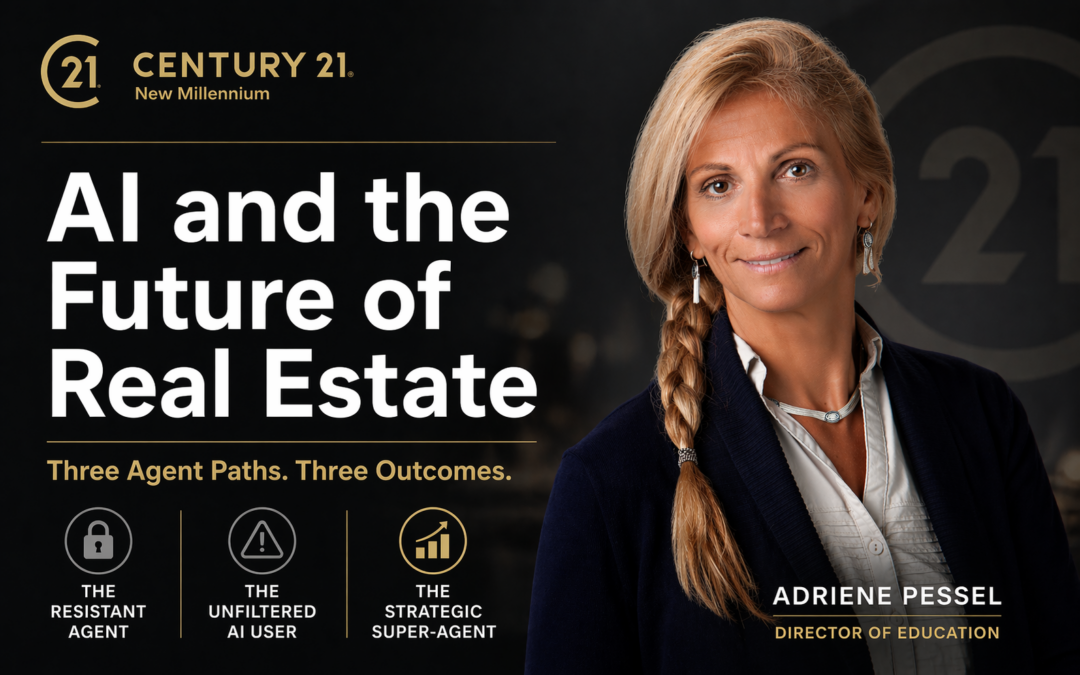
I’ve been through enough market cycles to spot patterns, and I use AI every day, both in my own business and in training agents on how to use it effectively. What I’m seeing now are three different paths professionals are starting to take.

The Resistant Agent
This agent tends to lean on what’s worked in the past. They’re a bit skeptical of AI, question how reliable it is, and often see it as something more suited for social media captions or surface-level tasks
Some agents also bring up the “hidden costs” of AI as a reason to stay away. And while fast-moving technology does come with real infrastructure concerns, some of that is already being addressed. Both the industry and government are seeing progress in newer data centers, and history shows that when there’s real financial opportunity, solutions follow. We are already seeing movement toward closed-loop systems and recycled water. While this area requires ongoing transparency and accountability, the “infrastructure excuse” for avoiding AI is becoming increasingly difficult to support.
Today’s client can compare neighborhoods, tax records, school boundaries, commute patterns, insurance considerations, and renovation cost estimates before ever calling an agent. When an agent’s research appears slower or less contextual, the difference is noticeable. Consumer expectations are evolving quietly and rapidly.
How It Shows Up
- Pricing guidance based only on MLS comps or automated value models, without deeper analysis of inventory shifts, concessions, or micro-trend movement.
- Generic listing copy with little testing of positioning or buyer targeting.
- Slower follow-up because communication must be built from scratch each time
- Missed details or inefficiencies that reduce leverage
Where It Leads
These professionals may not disappear, but they risk reduced differentiation and shrinking margins. As markets become more data-informed, clients increasingly reward speed, clarity, and precision.

The Unfiltered AI User
This group looks modern on the surface. They often use AI, but without a clear standard for checking or validating its output. They tend to copy outputs, lean on automated valuation language, and pass things along without adding context or taking ownership
AI can sound confident, even when it’s wrong. In real estate, small errors can have real consequences. A misstatement about a loan program, insurance coverage, property valuation, or repair responsibility can impact both the outcome and your credibility.
The Risk Behind the Shortcut
- Market content becomes repetitive and indistinguishable
- Misinformation circulates faster than corrections
- Legal and ethical boundaries blur
- Client interactions feel automated rather than advisory
- Documentation may lack defensible proof if challenged
Short-term efficiency does not replace long-term reputation. Clients remember accuracy, care, and accountability. Without verification standards, AI becomes a liability rather than an advantage.
AI-generated drafts, summaries, or explanations should always be reviewed against state-approved forms, brokerage compliance policies, and local regulations before being shared. Agents must remember they are not attorneys and should not give legal advice.

The Strategic Super-Agent
This professional treats AI like a junior analyst with unlimited stamina, not a replacement for their expertise. They use it to speed up research, organize complex information, and then apply their own judgment before presenting options to clients.
Using MLS data and/or SmartChart’s platform, an agent can quickly work through large amounts of data and start to see patterns and trends. From there, AI helps carry it further by organizing insights on absorption rates, zoning, mortgage history, resale risk, and appreciation trends.
Where AI Creates Real Advantage
Research Acceleration
Research acceleration is where AI starts to separate disciplined professionals from the rest. Instead of spending hours gathering data across MLS, public records, and local trends, agents can compress that work into minutes and focus on interpretation. The advantage is not just speed. It is the ability to layer data, test scenarios, and pressure-check assumptions before presenting guidance. AI can surface patterns that may go unnoticed, but it still requires agents to validate inputs, challenge conclusions, and translate findings into clear, client-specific advice. Faster research does not replace expertise. It raises the expectation that expertise shows up more informed and precise.
Client Communication Clarity
Using AI to organize and summarize lengthy documents such as inspection reports or condominium and HOA rules into readable formats. AI can help surface sections that address common consumer questions, such as restrictions for parking for commercial vehicles, or what restrictions involve pets, fences, or sheds. These tools assist in locating relevant language; they do not interpret legal meaning. Final interpretation rests with the consumer and any legal professional they choose to consult. The agent’s role is to promote clarity, encourage informed questions, and direct clients to appropriate resources when needed.
Contract Organization Support
Structuring timelines, summarizing addenda, and building compliance checklists while ensuring final review aligns with brokerage and state requirements.
Beyond analysis and structure, we are also seeing measurable improvements in how agents communicate and present.
“I used the workflow GPT from our training to help with my videos. It gave me feedback, and when I asked for examples, it guided me on structure. It became a rehearsal tool that really helped with my cadence and believability.” – Tiara Cobbin, CENTURY 21 New Millennium
“With the AI training we’ve received, we’re using these tools to analyze historical data from MLS, SmartCharts, and using the Federal government CPI calculator to create multiple benchmarks, allowing us to price homes more precisely than relying on a CMA or AVM approach alone.” – Amanda Newsome, CENTURY 21 New Millennium
We are entering a phase where advanced tools are no longer optional. To ignore them risks falling behind. To rely on them blindly misunderstands what clients truly seek.
As automation becomes more common, human presence becomes more valuable. We all have experienced the frustration of navigating automated systems and the relief of finally speaking with a capable human. Efficiency builds speed. Connection builds loyalty.
Artificial intelligence will not replace exceptional agents. It will raise the baseline. It will streamline research, sharpen analysis, and accelerate execution. What it can’t do is earn trust, interpret nuance, steady emotions, or stand confidently in moments of uncertainty.
The public will grow more informed and more discerning. They will expect speed and sophistication. They will also expect steadiness. The professionals who thrive in this next era will be those who master advanced tools without hiding behind them, who move quickly without becoming careless, and who translate complexity into clarity while maintaining presence.
This moment does not reward technology alone, nor tradition alone. It rewards disciplined integration of both.
That is the balance this profession now requires.
About the Author
Adriene Pessel is a lifetime Top Producer with more than three decades of experience, serving Fairfax County and Alexandria, VA. She is also the Director of Education at CENTURY 21 New Millennium. She has coached more than 1,500 professionals and focuses on elevating standards through the practical application of emerging tools and clear client communication.
Educational Resources
Adriene also produces short educational videos on emerging real estate topics, including responsible AI integration, market analysis, loan assumptions, CMAs, and navigating complex transactions. These videos are designed to help consumers and professionals better understand the decision process behind modern real estate practice. They are available on her YouTube channel, Real Life Real Estate, or on Spotify, Real Life Real Estate: Where Experience Matters.